


Scientific Name:
Peltogyne lecointei Duckei, Peltogyne confertiflora (Hayne) Benth Caesalpiniaceae.
Other Names and Related Species:
Pau-roxo, Coataquiçaua, Guarabu, Pau-roxo-da-Várzea, Violeta, Amarante
Foreign Nomenclature:
Amarante (French Guyana, France); Bois Violet (French Guyana); Purple heart (Guyana); Purple Heart (Guyana), Purper Hart (Suriname), Amaranth (EUA), Violet Holz (Germany, Colombia); Blue Wood (Colombia, Great Britain); Tananeo (Colombia).
Occurrence:
The P. leointei species is common in Maranhão and Pará, while P. confertiflora occurs in the states of Amazonas, Pará, Bahia, Maranhão, Piauí, Goiás, Mato Grosso, Minas Gerais and São Paulo.
General Features:
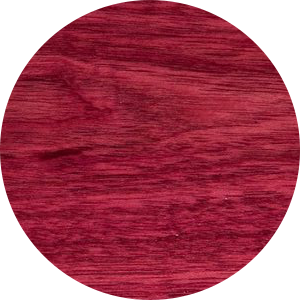
Heavy purple wood, with indistinct taste and smell. In P. confertiflora the texture is medium, and the grain is straight, while in P. lecointei the texture is smooth, and the grain is irregular.
Natural Durability:
Durable, resistant to fungus attack and soil contact.
Workability:
Its workability is difficult due to the high impermeability of the heartwood.
Suggested Uses:
This wood is used in heavy internal and external civil construction, in high quality furniture, domestic flooring, transportation, boats, decorative items, plywood panels, tool and utensil handles, cutlery, sports goods and toys, decoration and adornment and in the textile industry.
Processing:
Roxinho is a great wood for flattening, folding, bending, drilling, fixing, sanding and easy gluing, with good finishing. Drying is easy and may crack or warp during this operation.
Source: REMADE