


Scientific Name:
Astronium lecointei Ducke, Anacardiaceae.
Other Names and Related Species:
In its region of occurrence it’s called Aroeira, Maracatiara, Sanguessungueira, Aroeirão, Gonçalo-Alves, Maracatiara-Branca, Maracatiara-Vermelha, Muiracatiara-Rajada and Juiraquatiara. Other species of the Astronium ( A. fraxinifolium, A. graveolens, A. macrocalyx, A. urundeuva, A. ulei e A. balanae) genus have properties very similar to the Muirecatiara wood.
Description of the Tree:
Large tree, not very leafy. Commercial height ranging from 15 to 20 m with a diameter of 60 cm. It a forest it can reach a frequency of 0,1 to 1,6 trees/ha and a volume of 0,2 to 6,8 m3/ha.
Wood Characteristics:
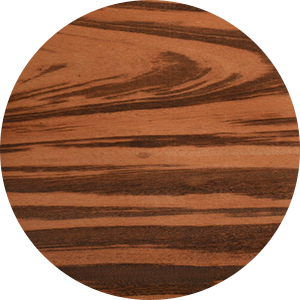
The heartwood is reddish-brown in color, marked with dark brown strips in a vertical direction, with variable spacing and beautifully distinct figures. Regular grain, medium texture, imperceptible smell and taste.
Region of Occurrence:
Wide distribution in the Amazon region reaching Acre, Amazonas, Rondônia and Roraima, also passing through Mato Grosso and Maranhão, with greater frequency in the state of Pará and Maranhão.
Physical-Mechanical Properties:
The Muiracatiara genus tipically is a very heavy wood, with high mechanical resistance and low retractability.
Behavior During Drying:
In air-drying, Muiracatiara wood presents warping and cracking problems. If the artificial drying is too drastic, deep cracking and surface hardening may occur.
Workability:
Muiracatiara wood is easy to work with and provides an excellent finish. It can be well painted, varnished, polished and kneaded.
Suggested Uses:
Carpentry and woodworking in general; in civil construction for uses such as beams, rafters, slats, bats and floorboards, door and window frames, framing, ceilings, paneling, etc.; cabinetmaking, tool handles and agricultural implements, luxury furniture, etc.
Source: REMADE