


Scientific Name:
Dipteryx odorata (Aubl.) Wild., Leguminosae.
Other Names and Related Species:
Cumaru-de-folha-grande, Cumbaru-roxo, Cumbaru.
Description of the Tree:
Large tree, often more than 50 m high, with 120 cm in diameter. Cylindrical trunk, with stem up to 18-24 m long.
Wood Characteristics:
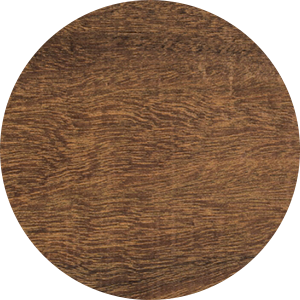
Light brown or brownish-blond color. Sapwood has a distinct, yellowish-brown. The surface is slightly to moderately glossy, waxy in appearance and smell similar to that of vanilla. Distinct taste.
Region of Occurrence:
Guyanas, Venezuela, Colombia and the Amazon region. It develops well in soils with good drainage.
Physical-Mechanical Properties:
Cumaru wood can be classified as having high specific weight, low retractability and high mechanical strength.
Behavior During Drying:
The wood is relatively easy to air-dry, with a small tendency to crack superficially. It is moderately warped. Artificial drying is slow, but practically free of defects.
Workability:
Difficult perforation; a smooth surface can be obtained if reverse grain is not present. Due to the oily nature of the wood, it is difficult to glue it together. It can be polished, painted, varnished, lacquered or immersed.
Suggested Uses:
Civil construction, decorative sliced blades, tool handles, agricultural implements, railroad crosspieces, linings, floorboards, etc.
Source: REMADE