


Scientific Name:
Cedrela fissilis Veli., Meliaceae.
Other Names and Related Species:
Cedro-branco, Cedro-rosa, Cedro-vermelho, Cedro-batata, Cedro-roxo. O gênero Cedrela, in Brazil, represented by three main species: C. odorata, C. angustifotia and C. fissilis. Its woods, similar in appearance and anatomical structure, are indistinctly known all over the country simply as Cedro; and, depending on the intensity of its brown color, by Cedro-rosa and Cedro-vermelho.
Description of the Tree:
Trees ranging from small (10 m high and 40 to 50 cm in diameter) to large (30 m high and 130 cm in diameter). Its cylindrical trunk is long and not very twisted. It has a gray-brown bark with large longitudinal, deep and very characteristic cracks.
Wood Characteristics:
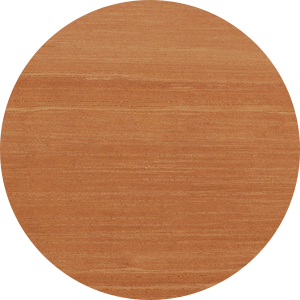
Heartwood ranging from dark-pink to reddish-brown and white and pinkish sapwood; glossy surface with golden highlights; characteristic, pleasant smell; slightly bitter taste; coarse texture; straight or slightly wavy grain.
Region of Occurrence:
Forests of the interior from the state of Minas Gerais to Rio Grande do Sul. It has a preference for humid soils at the bottom of valleys along rivers and in lowlands. C. odorata predominates in the Amazon region, while C. angusti folia is predominant in the Atlantic Forest. The Cedrela genus occurs from Mexico to Argentina.
Physical-Mechanical Properties:
It has low linear and volumetric retractability, mechanical properties between low and medium and is classified among the medium woods when it comes to density. The natural resistance against fungi and insects is small.
Behavior During Drying:
It is easy to dry in an oven, with no warping or cracking. Air-drying is fast, and the incidence of defects is small.
Workability:
Easy to work with both manual and mechanical instruments. Flattening produces a smooth and uniform surface. It has good retention of nails and screws, as well as excellent pigment absorption and polishing.
Suggested Uses:
Suitable for elegant furniture, decorative sliced sheets, picture frames, office supplies, musical instruments, etc. In internal construction (blinds, skirting boards, trims, linings, paneling, etc.), and in shipbuilding, as an internal decorative finish and hull of light vessels.
Source: REMADE